
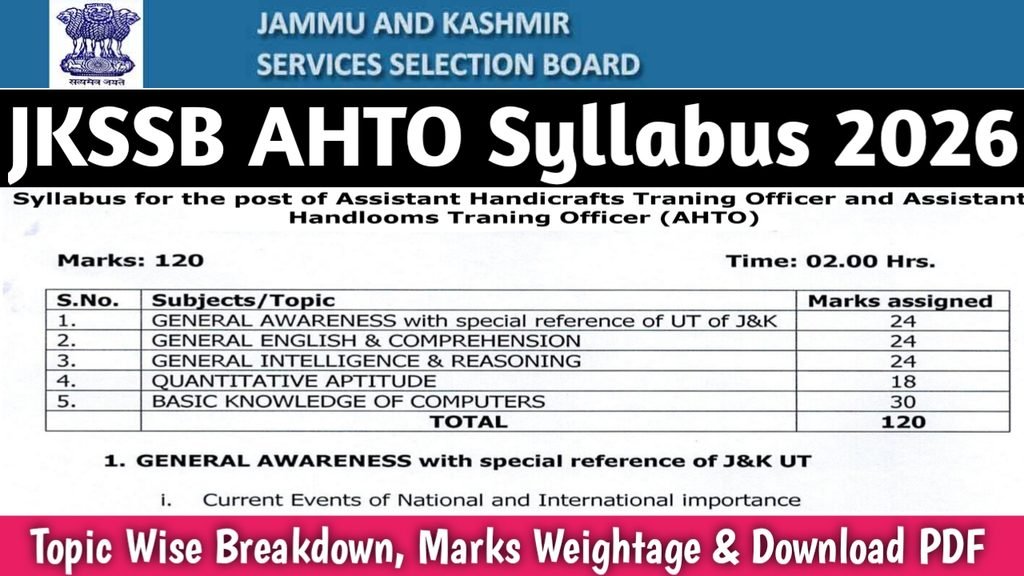
JKSSB AHTO Syllabus 2026: The Jammu and Kashmir Service Selection Board (JKSSB) has released a notification for 87 posts of Assistant Handicrafts/Handloom Training Officer (AHTO) through Advertisement No. 13 of 2025. Candidates who have applied for the post of JKSSB AHTO 2026 must prepare as per official syllabus topics to score maximum marks in the upcoming examination. This examination aims to test candidates knowledge of General Awareness with special reference to UT of J&K, General English & Comprehension, General Intelligence and Reasoning, Quantitative Aptitude & Basic Knowledge of Computers. The examination will be held in offline OMR mode which consists of 120 marks for 120 questions with a total duration of 120 minutes (02 hours). There will be negative marking of 0.25 for each incorrect answer. For subject wise syllabus topics, read the complete article.
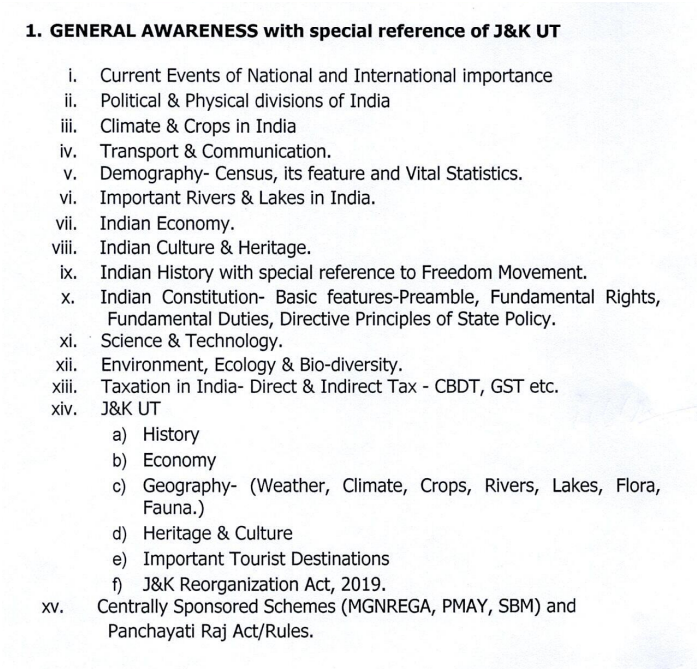
General Awareness with Special Reference to J&K UT
- Current Events of National and International Importance
- Political and Physical Divisions of India
- Climate and Crops in India
- Transport and Communication
- Demography – Census, Its Features and Vital Statistics
- Important Rivers and Lakes in India
- Indian Economy
- Indian Culture and Heritage
- Indian History with Special Reference to the Freedom Movement
- Indian Constitution:
- Basic Features
- Preamble
- Fundamental Rights
- Fundamental Duties
- Directive Principles of State Policy
- Science and Technology
- Environment, Ecology and Biodiversity
- Taxation in India – Direct and Indirect Taxes, CBDT, GST, etc.
- Jammu and Kashmir (J&K UT)
- History
- Economy
- Geography (Weather, Climate, Crops, Rivers, Lakes, Flora and Fauna)
- Heritage and Culture
- Important Tourist Destinations
- J&K Reorganisation Act, 2019
- Centrally Sponsored Schemes (MGNREGA, PMAY, SBM) and Panchayati Raj Act/Rules
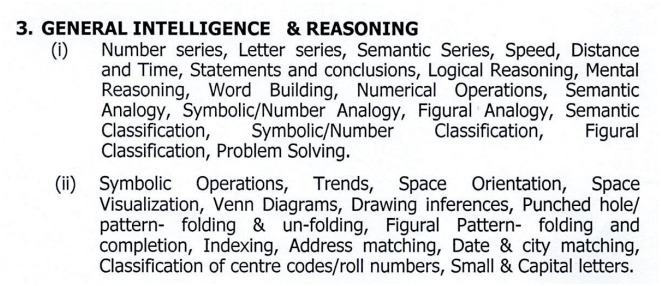
General Intelligence & Reasoning
- Number Series
- Letter Series
- Semantic Series
- Speed, Distance and Time
- Statements and Conclusions
- Logical Reasoning
- Mental Reasoning
- Word Building
- Numerical Operations
- Semantic Analogy
- Symbolic/Number Analogy
- Figural Analogy
- Semantic Classification
- Symbolic/Number Classification
- Figural Classification
- Problem Solving
- Symbolic Operations
- Trends
- Space Orientation
- Space Visualization
- Venn Diagrams
- Drawing Inferences
- Punched Hole/Pattern Folding and Unfolding
- Figural Pattern Folding and Completion
- Indexing
- Address Matching
- Date and City Matching
- Classification of Centre Codes/Roll Numbers
- Small and Capital Letters
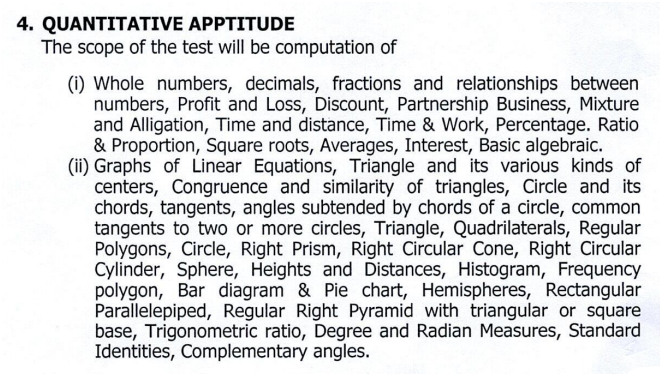
Quantitative Aptitude
The scope of the test will include the following topics:
Arithmetic and Basic Mathematics
- Whole Numbers
- Decimals
- Fractions and Relationships Between Numbers
- Profit and Loss
- Discount
- Partnership Business
- Mixture and Alligation
- Time and Distance
- Time and Work
- Percentage
- Ratio and Proportion
- Square Roots
- Averages
- Interest
- Basic Algebra
Geometry, Mensuration, Trigonometry and Data Interpretation
- Graphs of Linear Equations
- Triangle and Its Various Kinds of Centers
- Congruence and Similarity of Triangles
- Circle and Its Chords
- Tangents
- Angles Subtended by Chords of a Circle
- Common Tangents to Two or More Circles
- Triangles
- Quadrilaterals
- Regular Polygons
- Circle
- Right Prism
- Right Circular Cone
- Right Circular Cylinder
- Sphere
- Heights and Distances
- Histogram
- Frequency Polygon
- Bar Diagram
- Pie Chart
- Hemispheres
- Rectangular Parallelepiped
- Regular Right Pyramid with Triangular or Square Base
- Trigonometric Ratio
- Degree and Radian Measures
- Standard Identities
- Complementary Angles
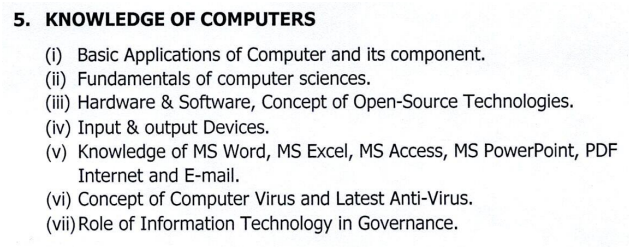
Knowledge of Computers
- Basic Applications of Computer and Its Components
- Fundamentals of Computer Science
- Hardware and Software
- Concept of Open-Source Technologies
- Input and Output Devices
- Knowledge of MS Word
- Knowledge of MS Excel
- Knowledge of MS Access
- Knowledge of MS PowerPoint
- Internet and E-mail
- Concept of Computer Virus and Latest Anti-Virus
- Role of Information Technology in Governance
JKSSB AHTO Exam Marks Weightage
| Subject/Topic | Marks Assigned | Weightage |
|---|---|---|
| General Awareness with Special Reference to UT of J&K | 24 | 20% |
| General English & Comprehension | 24 | 20% |
| General Intelligence & Reasoning | 24 | 20% |
| Quantitative Aptitude | 18 | 15% |
| Basic Knowledge of Computers | 30 | 25% |
| Total | 120 | 100% |
JKSSB AHTO Syllabus Breakdown (What To Study In Each Specific Topic)
For the ease of applicants, we’ll provide you JKSSB AHTO Syllabus (Breakdown) to help to understand what to study in each specific topic & prepare the high weightage topics thoroughly. This breakdown is solely made for candidates understanding & should not be treated as official.
JKSSB AHTO General Awareness Syllabus (What to Study In Each Topic)
Current Events of National and International Importance
- National current affairs
- International current affairs
- Important government appointments and resignations
- Awards and honours
- Sports tournaments, winners and records
- Important days and their themes
- Government schemes and initiatives
- Summits and international conferences
- Reports, indices and rankings
- Books and authors
- Important defence exercises and military operations
- Science and technology developments
- Space missions and satellite launches
- Important national and international organizations
- Major economic developments
- Important events related to Jammu and Kashmir
- New policies, laws and government decisions
Political and Physical Divisions of India
Political Divisions
- States and Union Territories of India
- Capitals of states and Union Territories
- Formation of states and Union Territories
- Reorganization of states
- Neighbouring countries of India
- Indian states sharing international borders
- Important border states
- Administrative divisions of India
- Major cities and their locations
- Important ports and coastal states
Physical Divisions
- The Himalayan Mountain System
- Northern Plains of India
- Peninsular Plateau
- Indian Desert
- Coastal Plains
- Islands of India
- Major mountain ranges and peaks
- Important mountain passes
- Major plateaus and hills
- Northern and southern river systems
- Western Ghats and Eastern Ghats
- Important geographical features of each region
Climate and Crops in India
Climate
- Factors affecting India’s climate
- Seasons of India
- Southwest monsoon
- Northeast monsoon
- Onset and withdrawal of monsoon
- Distribution of rainfall
- Western disturbances
- Cyclones and their effects
- El Niño and La Niña
- Climatic regions of India
- Droughts and floods
- Climate change and its effects on Indian agriculture
Crops
- Classification of crops: Kharif, Rabi and Zaid
- Major food crops: rice, wheat, maize and millets
- Commercial crops: cotton, jute and sugarcane
- Plantation crops: tea, coffee and rubber
- Oilseed crops
- Pulses
- Major producing states of important crops
- Soil and climatic requirements of crops
- Green Revolution
- White Revolution and other agricultural revolutions
- Major agricultural research institutions
- Irrigation methods and major irrigation projects
Transport and Communication
- Road transport in India
- National Highways and their numbering basics
- Expressways and important highway projects
- Railway zones and headquarters
- Important railway lines and railway projects
- Major railway stations and junctions
- Metro rail systems
- Inland waterways
- Major ports of India
- International airports and important domestic airports
- Civil aviation
- Transport corridors
- Important transport projects in Jammu and Kashmir
- Road, rail and tunnel connectivity in J&K
- Chenab Rail Bridge and USBRL project
Communication
- Postal services
- Telecommunications
- Mobile networks and internet services
- Radio and television broadcasting
- Satellite communication
- Optical fibre communication
- Digital India initiatives
- BharatNet
- 5G technology basics
- Important communication organizations and their functions
Demography – Census, Its Features and Vital Statistics
Census
- Meaning and purpose of a census
- Census history in India
- Census of 2011: important facts
- Population size and distribution
- Population density
- Population growth rate
- Sex ratio
- Child sex ratio
- Literacy rate
- Rural and urban population
- Population composition
- Scheduled Castes and Scheduled Tribes statistics
- Census terminology
- Census of India and the role of the Registrar General and Census Commissioner
Vital Statistics
- Birth rate
- Death rate
- Infant mortality rate
- Maternal mortality ratio
- Fertility rate
- Life expectancy
- Natural population growth
- Total fertility rate
- Crude birth and death rates
- Population pyramid
- Migration and urbanization
- Demographic dividend
C. J&K-Specific Demography
- Population and population density of J&K
- District-wise population facts from the relevant census
- Rural and urban population
- Literacy rate
- Sex ratio
- Scheduled Caste and Scheduled Tribe population
- Population distribution across different regions
Important Rivers and Lakes in India
Rivers
- Himalayan rivers and Peninsular rivers
- Indus river system
- Ganga river system
- Brahmaputra river system
- Godavari, Krishna, Kaveri and Mahanadi
- Narmada and Tapi
- Origin and mouth of major rivers
- Tributaries and distributaries
- East-flowing and west-flowing rivers
- River valleys and drainage patterns
- Major dams and multipurpose river projects
- Rivers shared by different states
- Important river-related environmental issues
Lakes
- Freshwater and saltwater lakes
- Natural and artificial lakes
- Wular Lake, Dal Lake, Chilika Lake and Loktak Lake
- Sambhar Lake and other saline lakes
- Important lakes and their locations
- Lakes associated with rivers
- Ramsar wetlands and their locations
- Important lake-related environmental issues
Indian Economy
Basic Economic Concepts
- Meaning of economics
- GDP, GNP, NNP and national income
- Per capita income
- Economic growth and development
- Inflation and deflation
- Poverty and unemployment
- Fiscal deficit and revenue deficit
- Economic sectors: primary, secondary and tertiary
Indian Economic Structure
- Agriculture and allied activities
- Industrial development
- Service sector
- Public and private sectors
- Small-scale industries and MSMEs
- Economic planning in India
- NITI Aayog
- Five-Year Plans: major objectives and achievements
- Economic reforms of 1991
- Liberalization, privatization and globalization
Banking and Finance
- Reserve Bank of India (RBI)
- Functions of commercial banks
- Repo rate and reverse repo rate
- CRR and SLR
- Monetary policy
- Fiscal policy
- Money supply
- Digital payments and UPI
- Financial inclusion
- Budget and taxation basics
Jammu and Kashmir Economy
- Agriculture and horticulture
- Apple production and other horticultural crops
- Tourism
- Handicrafts and handloom industries
- Silk and carpet industries
- Forestry and forest products
- Hydroelectric power
- Employment and economic development
- Major economic sectors of J&K
- Government initiatives for economic development
Indian Culture and Heritage
Art and Architecture
- Ancient Indian architecture
- Buddhist architecture: stupas, viharas and chaityas
- Temple architecture: Nagara, Dravida and Vesara
- Indo-Islamic architecture
- Mughal architecture
- Important monuments and historical sites
- Rock-cut architecture
- UNESCO World Heritage Sites in India
Classical and Folk Dances
- Bharatanatyam
- Kathak
- Kathakali
- Kuchipudi
- Odissi
- Manipuri
- Mohiniyattam
- Sattriya
- Important folk dances and their states
Music and Theatre
- Hindustani and Carnatic music
- Classical musical instruments
- Famous musicians and composers
- Folk music traditions
- Puppetry and traditional theatre
Literature and Cultural Traditions
- Ancient Indian literature
- Vedas, Upanishads and Puranas
- Buddhist and Jain literature
- Famous Indian authors and works
- Languages and scripts
- Major festivals of India
- Traditional paintings, crafts and textiles
Indian History with Special Reference to the Freedom Movement
Modern Indian History
- Arrival of European trading companies
- Establishment of British rule
- Battle of Plassey and Battle of Buxar
- Expansion of British territories
- Revolt of 1857
- Socio-religious reform movements
- British administrative and economic policies
Indian Freedom Movement
- Formation of the Indian National Congress
- Moderate and extremist phases
- Partition of Bengal and Swadeshi Movement
- Muslim League and the constitutional developments of the period
- Home Rule Movement
- Non-Cooperation Movement
- Civil Disobedience Movement
- Dandi March
- Quit India Movement
- Revolutionary movements
- Role of Mahatma Gandhi, Jawaharlal Nehru, Subhas Chandra Bose, Sardar Patel and other leaders
- Important sessions of the Indian National Congress
- Simon Commission
- Round Table Conferences
- Government of India Acts
- Cabinet Mission
- Mountbatten Plan
- Independence and Partition of India
Indian Constitution
- Making of the Indian Constitution
- Constituent Assembly
- Drafting Committee
- Adoption and commencement of the Constitution
- Sources of the Constitution
- Salient features
- Preamble and its key terms
- Sovereign, Socialist, Secular, Democratic and Republic
- Justice, Liberty, Equality and Fraternity
- Important constitutional amendments
Fundamental Rights
- Articles 12–35
- Right to Equality
- Right to Freedom
- Right against Exploitation
- Right to Freedom of Religion
- Cultural and Educational Rights
- Right to Constitutional Remedies
- Constitutional writs
- Right to Education
- Fundamental Rights and reasonable restrictions
- Article 51A
- List of Fundamental Duties
- 42nd and 86th Constitutional Amendments
- Difference between Fundamental Rights and Fundamental Duties
Directive Principles of State Policy
- Articles 36–51
- Socialist, Gandhian and liberal-intellectual principles
- Welfare state
- Difference between Fundamental Rights and Directive Principles
- President and Vice-President
- Prime Minister and Council of Ministers
- Parliament
- Supreme Court and High Courts
- Governor and Chief Minister
- State Legislature
- Election Commission
- Comptroller and Auditor General
- Finance Commission
- Emergency provisions
- Constitutional and statutory bodies
- Union-State relations
- Panchayati Raj and municipalities
Science and Technology
Physics
- Units and measurements
- Motion, force and laws of motion
- Work, energy and power
- Gravitation
- Heat and temperature
- Light: reflection and refraction
- Sound and its properties
- Electricity and magnetism
- Simple machines
- Sources of energy
Chemistry
- Elements, compounds and mixtures
- Atoms and molecules
- Acids, bases and salts
- Metals and non-metals
- Chemical reactions
- Periodic table basics
- Fuels and combustion
- Common chemicals and their uses
- Everyday chemistry
Biology
- Cell and its components
- Human body systems
- Nutrition and digestion
- Respiration and circulation
- Diseases and their causes
- Vitamins and deficiency diseases
- Blood groups
- Plant physiology
- Reproduction
- Genetics basics
- Microorganisms
- Vaccines and immunity
Technology
- Space research and ISRO
- Satellites and launch vehicles
- Computers and artificial intelligence basics
- Biotechnology
- Nanotechnology
- Nuclear technology
- Defence technology
- Renewable energy
- Recent scientific discoveries and innovations
Environment, Ecology and Biodiversity
Ecology
- Ecosystem and its components
- Food chains and food webs
- Ecological pyramids
- Energy flow
- Producers, consumers and decomposers
- Food webs and trophic levels
- Biogeochemical cycles
- Ecological succession
Environment
- Air, water, soil and noise pollution
- Greenhouse effect
- Global warming
- Climate change
- Ozone layer depletion
- Acid rain
- Waste management
- Renewable and non-renewable resources
- Environmental impact assessment
Biodiversity
- Levels of biodiversity
- Biodiversity hotspots
- Endangered and endemic species
- National parks and wildlife sanctuaries
- Biosphere reserves
- Tiger reserves and elephant reserves
- Ramsar sites
- Conservation programmes
- IUCN categories and Red List basics
- Important environmental conventions
- Dachigam National Park
- Hemis National Park
- Kishtwar National Park
- Salim Ali National Park
- Hangul conservation
- Snow leopard and Himalayan wildlife
- Important wetlands and Ramsar sites
- Forest types and biodiversity of J&K
- Environmental challenges in the Himalayan region
Taxation in India – Direct and Indirect Taxes
Direct Taxes
- Meaning and features of direct taxes
- Income tax
- Corporate tax
- Taxpayer and taxable income basics
- Tax deduction and tax collection concepts
- Central Board of Direct Taxes (CBDT)
- Role of the Income Tax Department
Indirect Taxes
- Meaning and features of indirect taxes
- Goods and Services Tax (GST)
- CGST, SGST, IGST and UTGST
- GST Council
- Central Board of Indirect Taxes and Customs (CBIC)
- Customs duty
- GST registration and invoice basics
- GST rates and slabs at a general level
- Difference between direct and indirect taxes
- Progressive, proportional and regressive taxation
- Tax evasion and tax avoidance
- Tax revenue and government expenditure
- Basic taxation-related budget terminology
Jammu and Kashmir Union Territory
This is a particularly important section because the syllabus specifically emphasizes J&K.
History
- Ancient history of Kashmir
- Important dynasties and rulers
- Lalitaditya Muktapida
- Sultanate period
- Zain-ul-Abidin
- Mughal rule in Kashmir
- Afghan and Sikh rule
- Dogra dynasty
- Maharaja Gulab Singh, Ranbir Singh, Pratap Singh and Hari Singh
- Treaty of Amritsar, 1846
- Events of 1947 and accession
- Political developments after independence
- Important historical personalities of Jammu and Kashmir
Economy
- Agriculture and horticulture
- Apple, walnut, saffron and other crops
- Tourism and pilgrimage tourism
- Handicrafts and handloom
- Carpet industry and papier-mâché
- Silk industry
- Hydroelectric projects
- Forestry and allied sectors
- Major economic development programmes
- Industrial development and employment initiatives
C. Geography
Weather and Climate
- Climate of Jammu, Kashmir and Ladakh
- Western disturbances
- Rainfall and snowfall patterns
- Seasons and climatic variations
Crops
- Rice, maize and wheat
- Apple, walnut, almond and cherry
- Saffron cultivation
- Important agricultural regions
Rivers and Lakes
- Jhelum, Chenab, Tawi, Ravi and Indus river systems
- Dal Lake, Wular Lake, Manasbal Lake and Pangong Tso
- Important glaciers and wetlands
- Major dams and hydroelectric projects
Flora and Fauna
- Forest types
- Deodar, pine, chinar and other important trees
- Hangul, snow leopard, Himalayan black bear and other wildlife
- National parks and wildlife sanctuaries
- Endemic and endangered species
Physical Geography
- Pir Panjal Range
- Greater Himalayas
- Kashmir Valley
- Jammu plains and hills
- Ladakh plateau and cold desert
- Important mountain passes
- Valleys, glaciers and high-altitude lakes
Heritage and Culture
- Kashmiri, Dogri, Gojri, Pahari and other regional languages
- Important literary personalities
- Sufism and Rishi tradition
- Shrines and religious heritage
- Traditional music and folk dances
- Rouf, Dumhal and other folk traditions
- Wazwan and traditional cuisine
- Kashmiri handicrafts
- Pashmina, carpets, papier-mâché and wood carving
- Traditional festivals and cultural practices
Important Tourist Destinations
- Srinagar and Dal Lake
- Gulmarg
- Pahalgam
- Sonamarg
- Yusmarg
- Doodhpathri
- Jammu
- Vaishno Devi
- Patnitop
- Bhaderwah
- Kishtwar
- Gurez Valley
- Mughal Gardens
- Important pilgrimage and heritage sites
Jammu and Kashmir Reorganisation Act, 2019
- Background and purpose of the Act
- Abrogation of Article 370 and changes to Article 35A
- Jammu and Kashmir Reorganisation Act, 2019
- Formation of the Union Territories of Jammu and Kashmir and Ladakh
- Legislative Assembly and Lieutenant Governor
- Administrative structure of the Union Territory
- Parliament’s role and relevant constitutional provisions
- Districts and administrative divisions
- Important changes to governance and administration
- Difference between a state and a Union Territory with a legislature
Centrally Sponsored Schemes and Panchayati Raj Act/Rules
For every scheme, study its launch year, ministry, objective, beneficiaries, eligibility, financial assistance and implementation mechanism.
MGNREGA
- Full form and objectives
- Employment guarantee provisions
- Number of guaranteed employment days
- Eligibility and job cards
- Wage payments
- Role of Gram Panchayats
- Social audits
- Unemployment allowance provisions
PMAY (Pradhan Mantri Awas Yojana)
- PMAY-Gramin and PMAY-Urban
- Objectives and beneficiaries
- Eligibility criteria
- Financial assistance
- House construction and basic facilities
- Implementation agencies
SBM (Swachh Bharat Mission)
- SBM-Gramin and SBM-Urban
- Objectives of sanitation and cleanliness
- Individual household toilets
- Open-defecation-free initiatives
- Solid and liquid waste management
- Rural and urban implementation
Other Important Government Schemes
- National Rural Livelihoods Mission (NRLM)
- National Social Assistance Programme (NSAP)
- Jal Jeevan Mission
- Ayushman Bharat
- PM-KISAN
- Pradhan Mantri Ujjwala Yojana
- National Health Mission
- PM Gram Sadak Yojana
- Digital India
- Other important schemes specified in current official updates
Panchayati Raj
- Meaning and importance of Panchayati Raj
- 73rd Constitutional Amendment
- Part IX of the Constitution
- Gram Sabha and Gram Panchayat
- Panchayat Samiti and Zila Parishad
- Three-tier Panchayati Raj system
- Panchayat elections
- Reservation of seats
- Tenure of Panchayats
- State Election Commission
- State Finance Commission
- Eleventh Schedule
- Functions and powers of Panchayats
- Sources of Panchayat revenue
- Gram Sabha meetings and social audits
J&K Panchayati Raj Act and Rules
- Jammu and Kashmir Panchayati Raj Act, 1989, as amended
- Jammu and Kashmir Panchayati Raj Rules
- Structure of Panchayats in J&K
- Halqa Panchayat
- Sarpanch and Panch
- Block Development Council
- District Development Council
- Gram Sabha and its functions
- Powers and duties of elected representatives
- Panchayat elections and tenure
- Reservation provisions
- Local development planning
- Panchayat finances and accountability
JKSSB AHTO General English Syllabus (What to Study in Each Topic)
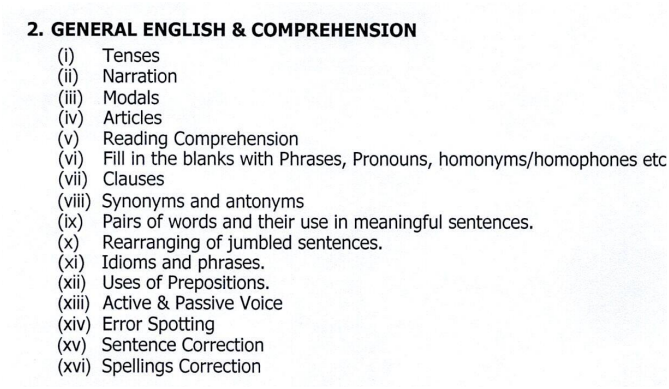
Tenses
- Present, Past and Future Tenses
- Simple, Continuous, Perfect and Perfect Continuous
- Rules of tense usage
- Sequence of tenses
- Tense-based error detection and sentence correction
Narration (Direct and Indirect Speech)
- Rules for changing direct into indirect speech
- Statements
- Interrogative sentences
- Imperative sentences
- Exclamatory sentences
- Changes in tense, pronouns, time and place expressions
Modals
- Can, Could, May, Might
- Shall, Should, Will, Would
- Must, Ought to, Need, Dare
- Have to, Has to, Had to
- Rules and usage of modals
Articles
- Definite article: The
- Indefinite articles: A and An
- Use and omission of articles
- Articles with geographical names, institutions and proper nouns
- Common errors in article usage
Reading Comprehension
- Reading unseen passages
- Identifying the main idea and central theme
- Finding specific information
- Drawing inferences and conclusions
- Meaning of words in context
- Author’s tone and purpose
- Choosing suitable titles
- Fact-based and vocabulary-based questions
Fill in the Blanks
- Phrases and expressions
- Pronouns
- Homonyms and homophones
- Articles
- Prepositions
- Conjunctions
- Verbs and tenses
- Subject-verb agreement
- Adjectives and adverbs
- Vocabulary and contextual usage
Clauses
- Noun clauses
- Adjective clauses
- Adverb clauses
- Independent and dependent clauses
- Main and subordinate clauses
- Relative clauses
- Identification and usage of clauses
Synonyms and Antonyms
- Synonyms (words with similar meanings)
- Antonyms (words with opposite meanings)
- Commonly tested vocabulary
- One-word vocabulary questions
- Words used in sentences
- Contextual synonyms and antonyms
Pairs of Words and Their Use in Meaningful Sentences
- Commonly confused words
- Homonyms and homophones
- Similar-sounding words
- Words with different meanings and spellings
- Correct usage of words in sentences
- Examples: accept/except, affect/effect, advice/advise, principal/principle
Rearranging of Jumbled Sentences
- Rearrangement of words to form sentences
- Rearrangement of sentences to form paragraphs
- Identifying the opening and concluding sentences
- Logical sequence of ideas
- Connectors and linking words
- Coherence and sentence flow
Idioms and Phrases
- Common English idioms
- Meaning of idiomatic expressions
- Phrases and their meanings
- Correct usage in sentences
- Replacing expressions with suitable idioms
- Frequently confused idioms
Uses of Prepositions
- Prepositions of time: in, on, at
- Prepositions of place: in, on, at
- Prepositions of direction and movement
- Prepositions of position
- Prepositions after verbs
- Prepositions after adjectives
- Prepositions after nouns
- Fixed prepositional phrases
- Common errors in preposition usage
Active and Passive Voice
- Identification of active and passive voice
- Rules for changing active into passive
- Voice changes across tenses
- Modal verbs in passive voice
- Passive voice with interrogative sentences
- Passive voice with imperative sentences
- Passive voice with two objects
- Sentences that cannot be changed into passive voice
Error Spotting
- Subject-verb agreement
- Tenses
- Articles
- Prepositions
- Pronouns
- Adjectives and adverbs
- Nouns and number
- Conjunctions
- Modals
- Active and passive voice
- Direct and indirect speech
- Parallelism and sentence structure
- Common grammatical errors
Sentence Correction
- Grammatical sentence correction
- Subject-verb agreement
- Tense correction
- Incorrect use of articles and prepositions
- Pronoun errors
- Incorrect modifiers
- Redundancy and wordiness
- Incorrect word usage
- Sentence improvement
- Correct sentence structure
Spellings Correction
- Commonly misspelled words
- Correct spelling of frequently used words
- Confusing spellings
- Silent letters
- Double consonants
- Common spelling patterns
- British and American spelling differences
- Frequently confused word forms
JKSSB AHTO General Intelligence & Reasoning Syllabus (What to Study in Each Topic)
Number Series
- Missing number series
- Number patterns
- Difference and multiplication patterns
- Squares, cubes and alternating series
Letter Series
- Alphabetical order and positions
- Missing letters
- Letter patterns
- Forward and backward sequences
Semantic Series
- Word-based sequences
- Logical arrangement of words
- Relationships between words
- Identifying the odd word in a sequence
Speed, Distance and Time
- Basic speed, distance and time problems
- Relative speed
- Average speed
- Trains and related problems
Statements and Conclusions
- Identifying valid conclusions
- Logical deductions
- Facts versus assumptions
- Drawing conclusions from given statements
Logical Reasoning
- Syllogisms
- Cause and effect
- Assertion and reason
- Assumptions and arguments
- Inferences and deductions
Mental Reasoning
- Analytical reasoning
- Logical puzzles
- Decision-making
- Problem-solving
- Relationship-based questions
Word Building
- Forming words from given letters
- Meaningful word formation
- Dictionary order
- Letter arrangement
Numerical Operations
- Basic arithmetic operations
- Missing mathematical operators
- Interchanging operators
- Simplification-based reasoning
Semantic Analogy
- Word relationships
- Synonyms and antonyms
- Object and function
- Part and whole
- Cause and effect
Symbolic/Number Analogy
- Number relationships
- Mathematical patterns
- Symbol-based relationships
- Identifying analogous number pairs
Figural Analogy
- Relationship between figures
- Shape transformations
- Rotation and reflection
- Figure-based patterns
Semantic Classification
- Odd one out
- Classification of words
- Grouping by meaning
- Identifying common characteristics
Symbolic/Number Classification
- Number-based odd one out
- Symbol-based grouping
- Identifying different mathematical patterns
- Classification based on numerical properties
Figural Classification
- Figure-based odd one out
- Shape classification
- Identifying common patterns
- Differences in orientation and structure
Problem Solving
- Logical puzzles
- Numerical problems
- Analytical questions
- Relationship-based problems
- Multi-step reasoning
Non-Verbal and Special Reasoning
Symbolic Operations
- Substitution of symbols
- Interchanging mathematical signs
- Symbol-based calculations
- Evaluating expressions using given rules
Trends
- Number and letter trends
- Pattern identification
- Changes in figures
- Identifying the next item in a sequence
Space Orientation
- Direction sense
- Movement and turns
- Relative positions
- Direction-based problems
Space Visualization
- Rotation of figures
- Reflection and mirror images
- Water images
- Identifying shapes from different perspectives
Venn Diagrams
- Two-set and three-set diagrams
- Relationships between groups
- Overlapping categories
- Logical representation of statements
Drawing Inferences
- Drawing conclusions from given information
- Identifying implied facts
- Logical deductions
- Interpreting diagrams and patterns
Punched Hole/Pattern Folding and Unfolding
- Paper folding
- Hole punching
- Predicting unfolded patterns
- Symmetry and reflection
Figural Pattern Folding and Completion
- Completing incomplete figures
- Identifying missing parts
- Pattern continuation
- Figure matching
Indexing
- Alphabetical indexing
- Numerical indexing
- Finding entries using given codes
- Arranging and locating information
Address Matching
- Comparing addresses
- Identifying matching entries
- Detecting differences in address details
- Matching records accurately
Date and City Matching
- Matching dates with cities
- Identifying corresponding entries
- Comparing records
- Detecting mismatches
Classification of Centre Codes/Roll Numbers
- Matching examination centre codes
- Comparing roll numbers
- Identifying incorrect entries
- Classification of numerical and alphanumeric codes
Small and Capital Letters
- Identifying lowercase and uppercase letters
- Letter sequence recognition
- Matching letters
- Distinguishing similar-looking characters
- Identifying patterns involving capital and small letters
JKSSB AHTO Quantitative Aptitude (What to Study in Each Topic)
Whole Numbers
- Natural numbers and whole numbers
- Integers and number properties
- Divisibility rules
- Factors and multiples
- HCF and LCM
Decimals
- Decimal operations
- Conversion between decimals and fractions
- Comparing decimals
- Rounding off
Fractions and Relationships Between Numbers
- Types of fractions
- Fraction operations
- Simplification
- Comparison of fractions
- Number relationships
Profit and Loss
- Cost price and selling price
- Profit and loss percentages
- Marked price
- Successive profit and loss
Discount
- Marked price and selling price
- Single discount
- Successive discounts
- Discount percentage
Partnership Business
- Investment ratios
- Time-based investments
- Profit-sharing ratios
- Changes in investment
Mixture and Alligation
- Mixing two or more substances
- Mean price
- Alligation rule
- Replacement problems
Time and Distance
- Speed, distance and time
- Average speed
- Relative speed
- Trains, boats and streams
Time and Work
- Work efficiency
- Individual and combined work
- Work and wages
- Pipes and cisterns
Percentage
- Basic percentage calculations
- Fraction-to-percentage conversion
- Percentage increase and decrease
- Successive percentage changes
Ratio and Proportion
- Simplifying ratios
- Direct and inverse proportion
- Dividing quantities in a ratio
- Fourth proportional and related problems
Square Roots
- Perfect squares
- Square-root calculations
- Simplification
- Estimation of square roots
Averages
- Basic average
- Combined average
- Missing values
- Changes in average
Interest
- Simple interest
- Compound interest
- Difference between simple and compound interest
- Principal, rate and time
Basic Algebra
- Algebraic expressions
- Algebraic identities
- Linear equations
- Simplification
- Basic factorization
Graphs of Linear Equations
- Linear equations in two variables
- Coordinates and plotting points
- Graphs of straight lines
- Intercepts and solutions
Triangle and Its Various Kinds of Centers
- Types of triangles
- Centroid
- Incentre
- Circumcentre
- Orthocentre
- Basic properties of triangles
Congruence and Similarity of Triangles
- Congruence rules: SSS, SAS, ASA and RHS
- Similarity criteria
- Corresponding sides and angles
- Ratios of areas
Circle and Its Chords
- Radius, diameter and chord
- Properties of chords
- Equal chords
- Chord-related theorems
Tangents
- Tangent to a circle
- Radius perpendicular to tangent
- Lengths of tangents from an external point
Angles Subtended by Chords of a Circle
- Angles at the centre and circumference
- Angles in the same segment
- Cyclic quadrilaterals
- Related circle theorems
Common Tangents to Two or More Circles
- Direct common tangents
- Transverse common tangents
- Number of common tangents
- Basic tangent-length problems
Triangles
- Angle sum property
- Exterior angle theorem
- Pythagoras theorem
- Perimeter and area
- Special triangles
Quadrilaterals
- Square, rectangle, parallelogram and rhombus
- Trapezium
- Properties of sides and angles
- Perimeter and area
Regular Polygons
- Interior and exterior angles
- Sum of interior angles
- Number of sides
- Regular polygon properties
Circle
- Circumference
- Area
- Arc length
- Sector area
- Semicircles and related problems
Right Prism
- Faces, edges and vertices
- Lateral surface area
- Total surface area
- Volume
Circular Cone
- Radius, height and slant height
- Curved surface area
- Total surface area
- Volume
Right Circular Cylinder
- Curved surface area
- Total surface area
- Volume
- Hollow cylinder basics
Sphere
- Surface area
- Volume
- Radius and diameter relationships
Heights and Distances
- Angle of elevation
- Angle of depression
- Application of trigonometric ratios
- Height and distance calculations
Histogram
- Frequency distribution
- Class intervals
- Drawing and interpreting histograms
- Comparing frequencies
Frequency Polygon
- Class marks
- Frequency distribution
- Construction of frequency polygons
- Interpretation of data
Bar Diagram
- Simple bar graphs
- Multiple bar graphs
- Comparing quantities
- Data-based calculations
Pie Chart
- Sector angles
- Percentage distribution
- Conversion between fractions, percentages and angles
- Data interpretation
Hemispheres
- Curved and total surface area
- Volume
- Solid hemisphere problems
Rectangular Parallelepiped (Cuboid)
- Length, breadth and height
- Surface area
- Volume
- Diagonal
Regular Right Pyramid with Triangular or Square Base
- Base area
- Slant height and vertical height
- Lateral and total surface area
- Volume of triangular and square pyramids
Trigonometric Ratios
- Sine, cosine and tangent
- Cosecant, secant and cotangent
- Standard angle values
- Relationships between trigonometric ratios
- Basic trigonometric problems
Degree and Radian Measures
- Conversion between degrees and radians
- Standard angle conversions
- Angular measurement
Standard Identities
- Fundamental trigonometric identities
- Reciprocal identities
- Quotient identities
- Simplification using identities
Complementary Angles
- Complementary angle relationships
- Trigonometric ratios of complementary angles
- Applications of complementary-angle identities
JKSSB AHTO Computer Syllabus (What to Study in Each Topic)
Basic Applications of Computer and Its Components
- Definition and characteristics of computers
- Generations of computers
- Types of computers: analog, digital and hybrid
- Classification: microcomputer, minicomputer, mainframe and supercomputer
- Basic applications of computers
- Components of a computer system
- CPU, ALU and Control Unit
- Input, processing, output and storage
- Memory: RAM, ROM and cache
- Primary and secondary memory
- Units of memory: bit, byte, KB, MB, GB and TB
- Booting and types of booting
Fundamentals of Computer Science
- Basics of computer science
- Data and information
- Data processing cycle
- Number systems: binary, decimal, octal and hexadecimal
- Binary number conversions
- Computer languages: machine, assembly and high-level languages
- Basics of programming
- Operating systems and their functions
- Types of operating systems
- Files, folders and file extensions
- Database fundamentals
- Computer networks: LAN, MAN and WAN
- Internet, intranet and extranet
Hardware, Software and Open-Source Technologies
Hardware
- Definition and types of hardware
- Motherboard and processor
- CPU components
- RAM, ROM and storage devices
- Hard disk, SSD, pen drive and memory card
- Printers, scanners and monitors
- Ports and connectors
Software
- System software
- Application software
- Utility software
- Operating systems
- Drivers and firmware
- Licensed, proprietary and freeware software
- Difference between hardware and software
Open-Source Technologies
- Meaning of open-source software
- Open-source versus proprietary software
- Linux operating system
- LibreOffice
- Mozilla Firefox
- Open-source licenses: basic concepts
- Advantages and limitations of open-source software
Input and Output Devices
Input Devices
- Keyboard and mouse
- Scanner
- Microphone
- Webcam
- Touchscreen
- Joystick
- Light pen
- Barcode and QR code readers
- OCR, OMR and MICR
- Biometric devices
Output Devices
- Monitor and display types
- Printers: impact and non-impact
- Laser, inkjet and dot-matrix printers
- Speakers and headphones
- Projectors
- Plotters
- Soft copy and hard copy
Microsoft Word
- Introduction to MS Word
- Creating, opening and saving documents
- Editing and formatting text
- Font styles, size and colour
- Paragraph alignment and spacing
- Bullets and numbering
- Page margins and orientation
- Headers and footers
- Page numbering
- Tables and inserting pictures
- Find and Replace
- Spelling and grammar check
- Mail Merge
- Print settings
- Keyboard shortcuts and file extensions
MS Excel
- Introduction to spreadsheets
- Workbook, worksheet, rows and columns
- Cells, cell references and ranges
- Entering and formatting data
- Formulas and operators
- Functions: SUM, AVERAGE, COUNT, MAX and MIN
- IF function
- Relative and absolute cell references
- Sorting and filtering
- Charts and graphs
- Conditional formatting
- Data validation
- AutoFill
- Freeze Panes
- Basic PivotTable concepts
- Excel file extensions and shortcuts
MS Access
- Introduction to database management systems
- Tables, records and fields
- Primary keys and foreign keys
- Data types
- Queries
- Forms
- Reports
- Relationships between tables
- Basic database operations
- MS Access file extension
Microsoft PowerPoint
- Introduction to presentations
- Creating and saving presentations
- Slides and slide layouts
- Themes and templates
- Inserting text, images, tables and charts
- Transitions and animations
- Slide Show view
- Slide Master
- Speaker notes
- Printing slides and handouts
- PowerPoint shortcuts and file extensions
- Meaning and full form of PDF
- Features and uses of PDF files
- Creating and opening PDF files
- PDF readers
- Converting documents to PDF
- Printing and sharing PDF files
- Merging and splitting PDF files
- Password protection and digital signatures
- Difference between PDF and editable document formats
Internet and E-mail
Internet
- Meaning and working of the internet
- World Wide Web (WWW)
- Web browsers and search engines
- Websites, webpages and hyperlinks
- URL, domain name and IP address
- HTTP and HTTPS
- Downloading and uploading
- Internet protocols: TCP/IP, FTP and DNS basics
- Wi-Fi, broadband and mobile internet
- Cloud computing basics
- Cybersecurity and safe browsing
- Meaning and uses of e-mail
- E-mail address structure
- To, CC and BCC
- Subject line and attachments
- Inbox, Sent, Drafts, Spam and Trash
- Reply, Reply All and Forward
- E-mail etiquette
- Phishing and suspicious attachments
- Spam e-mails
- Email protocols: SMTP, POP3 and IMAP
Concept of Computer Virus and Latest Anti-Virus
- Meaning of computer virus
- Types of malware: virus, worm, Trojan horse, spyware, ransomware and adware
- How viruses spread
- Symptoms of malware infection
- Antivirus software and its functions
- Real-time protection and scanning
- Firewall and its purpose
- Updating antivirus software
- Safe downloading and browsing
- Password security and multi-factor authentication
- Data backup and recovery
- Examples of antivirus products and their basic features
Role of Information Technology in Governance
- Meaning of e-governance
- Objectives and benefits of e-governance
- Government-to-Citizen (G2C) services
- Government-to-Government (G2G) services
- Government-to-Business (G2B) services
- Government-to-Employee (G2E) services
- Digital India programme
- Aadhaar and digital identity
- DigiLocker
- UMANG
- Common Service Centres (CSCs)
- Digital payments and UPI
- Direct Benefit Transfer (DBT)
- E-Courts and online public services
- Cybersecurity in government systems
- Digital signatures and electronic records
- IT Act, 2000: basic awareness
- E-governance initiatives in Jammu and Kashmir
Important Links
| JKSSB AHTO WhatsApp Group Link | JOIN NOW |
| JKSSB AHTO Syllabus | Download PDF |
| Official Website | CLICK HERE |
Pingback: JKSSB AHTO Syllabus 2026 Subject- Wise Topics & Download PDF jkssb nic in