
JKSSB Female Supervisor Syllabus 2026: The Jammu and Kashmir Service Selection Board (JKSSB) has released a notification for the recruitment of Female Supervisor (under Mission Poshan/ Advt. No. 13 of 2025) across various departments. These posts are reserved for female candidates only (male candidates are not eligible). Candidates who have applied for the must check the JKSSB Female Supervisor syllabus topics to prepare for the upcoming examination systematically. This examination aims to test candidates knowledge of General Awareness (with special reference to UT of J&K), General English & Comprehension, General Intelligence & Reasoning, General Science, Computer (Application based), Specialization. We have also provided JKSSB Female Supervisor Syllabus (Topic wise Breakdown, i.e; What to study in Each Specific Topic) to help you understand what to study. For more details, read the complete article.
General Knowledge with Special Reference to J&K
- Current Events of National Importance
- Indian History, Culture, Heritage and Freedom Struggle/Movement
- Indian Constitution
- Basic Features
- Preamble
- Fundamental Rights
- Fundamental Duties
- Directive Principles of State Policy
- Political and Physical Divisions of India
- Demography – Census, its Features and Functions
- Weather, Climate, Crops and Means of Transport of India
- Environment, Ecology and Biodiversity
- Jammu & Kashmir UT
- History
- Geography
- Economy
- Heritage and Culture
- J&K Reorganization Act, 2019
English & Comprehension
- Tenses
- Rearranging of Jumbled Sentences
- Narration
- Modals/Articles
- Clauses
- Synonyms and Antonyms
- Pairs of Words and Their Use in Meaningful Sentences
- Idioms and Phrases
- Uses of Prepositions
- Active and Passive Voice
General Intelligence & Reasoning
Basic Arithmetic
- Number System
- Percentage
- Average
- Profit and Loss
- Ratio and Proportion
- Time and Work
Reasoning
- Number Series
- Letter Series
- Coding-Decoding
- Direction Sense
- Blood Relations
- Mathematical Reasoning
- Speed, Distance and Time
- Statements and Conclusions
General Science
- Various Sources of Energy
- Nutrition and Its Types
- Respiration
- Transportation of Water, Food and Minerals in Plants
- Communicable and Non-Communicable Diseases
- Vitamins and Diseases Related to Vitamin Deficiency
- Ecosystem: Its Components, Food Chains and Food Webs
- Environmental Pollution
- Ozone Layer and Its Depletion
- Greenhouse Effect
- Vaccines and Immunization
Computer
- Basic Applications of Computers and Their Components
- Fundamentals of Computer Science
- Input and Output Devices
- Knowledge of MS Word, MS Excel, MS Access, MS PowerPoint, PDF, Internet and E-mail
- Concept of Computer Viruses and Antivirus
- Hardware and Software
- Elements of a Computer Processing System
- Hardware: CPU, Peripherals and Storage Media
- Software: Definition, Role and Categories
- Firmware and Humanware
- Role of Information Technology in Governance
Specialization
Sociology
- Society, Community and Association
- Social Stratification: Caste, Class and Social Stratification in India
- Social Institutions: Norms, Values, Folkways and Mores
- Marriage, Kinship and Family
- Social Change: Industrialization, Globalization and Modernization
Gender, Human Development and Psychology
- Gender Inequalities and Issues
- Gender Law and Human Rights
- Stages and Theories of Human Development: Freud and Erikson
- Socialization and Its Theories
- Anxiety Disorders:
- Phobia
- Obsessive-Compulsive Disorder (OCD)
- Generalized Anxiety Disorder (GAD)
- Panic Disorder
- Post-Traumatic Stress Disorder (PTSD)
Human Rights, Gender and Social Issues
- Human Rights: Concept and Evolution
- Universal Declaration of Human Rights (UDHR)
- Understanding Sex, Gender and Sexual Division of Labour
- Women’s Rights and Child Rights
- Social Evils:
- Child Abuse
- Child Labour
- Female Foeticide
- Infanticide
- Drug Addiction
Social Problems and Development
- Poverty and Unemployment
- Population Explosion
- Global Warming and Climate Change
- Indicators of Social Development
- Trafficking, Beggary and Corruption
Nutrition, Health and Food Science
- Growth and Development
- Food, Nutrition, Health and Fitness
- Physiology and Promoting Health
- Food Science and Processing
- Chemical Analysis of Food
- Food and Personal Hygiene
Government Schemes and Welfare Programmes
- Government and Non-Government Programmes:
- Medical Health Care
- Adoption and Foster Care
- Institutional Care
- Children Act and Children’s Rights
- Health and Family Welfare Programmes
- Early Childhood Care and Education
- Old Age and Disability Schemes
- Poshan Abhiyan
- Poshan Tracker
- Poshan Vatikas
- Supplementary Nutrition Programme
- Anganwadi Services
- Pradhan Mantri Matru Vandana Yojana (PMMVY)
- Scheme for Adolescent Girls (SAG)
- Janani Suraksha Yojana (JSY)
- National Health Mission (NHM)
- Paalna: Convergence of Anganwadi Centres into Crèches
- Ladli Beti Scheme
- State Marriage Assistance Scheme
JKSSB Female Supervisor Syllabus 2026 PDF
JKSSB AHTO Syllabus Breakdown (What To Study In Each Specific Topic)
For the ease of applicants, we’ll provide you JKSSB Female Supervisor Syllabus (Breakdown) to help to understand what to study in each specific topic & prepare the high weightage topics thoroughly. This breakdown is solely made for candidates understanding & should not be treated as official.
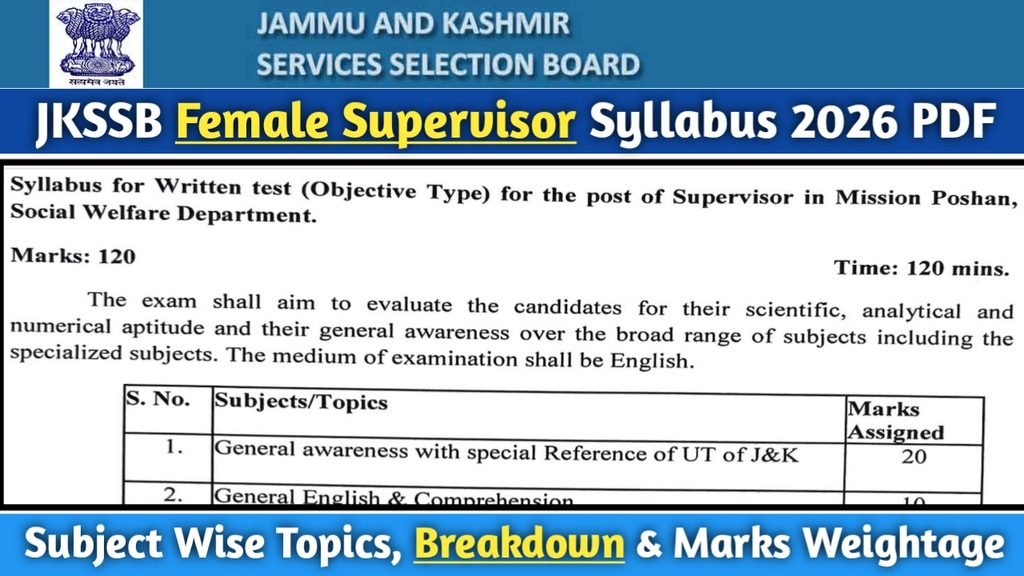
JKSSB Female Supervisor 2026 Marks Weightage
| Subjects/Topics | Marks Assigned |
|---|---|
| General Awareness with Special Reference to UT of J&K | 20 |
| General English & Comprehension | 10 |
| General Intelligence & Reasoning | 10 |
| General Science | 10 |
| Computer (Application Based) | 10 |
| Specialization | 60 |
| Total Marks | 120 Marks |
General Knowledge with Special Reference to J&K
Current Events of National Importance
- Major national news and government decisions
- Important appointments and resignations
- Awards and honours
- National and international summits hosted by India
- Important days and their themes
- Sports tournaments, winners and records
- Books and authors
- Important reports and indices released by Indian institutions
- Major defence exercises, missiles and space missions
- Government schemes and initiatives
- Important national institutions and organisations
- Census updates and major economic developments
Indian History: Freedom Struggle
Modern Indian History
- Arrival of Europeans and establishment of British rule
- Revolt of 1857: causes, leaders and consequences
- Social and religious reform movements
- Formation of the Indian National Congress
- Partition of Bengal and Swadeshi Movement
- Non-Cooperation, Civil Disobedience and Quit India movements
- Role of Mahatma Gandhi, Subhas Chandra Bose, Bhagat Singh and other freedom fighters
- Revolutionary movements and important organisations
- Independence, Partition and integration of princely states
Indian Culture and Heritage
- Classical dances and folk dances
- Classical music traditions
- Folk music and musical instruments
- Indian paintings and handicrafts
- Temples, stupas, forts and monuments
- UNESCO World Heritage Sites in India
- Major festivals, fairs and cultural traditions
- Important books, languages and literary personalities
Indian Constitution
Basic Features
- Meaning and importance of a Constitution
- Sources of the Indian Constitution
- Constituent Assembly: formation, committees and important members
- Adoption and commencement of the Constitution
- Salient features of the Constitution
- Federal system and parliamentary government
- Separation of powers
- Constitutional amendment procedure
- Important constitutional amendments
Preamble
- Meaning of the Preamble
- Sovereign, Socialist, Secular, Democratic and Republic
- Justice, Liberty, Equality and Fraternity
- Words added by the 42nd Constitutional Amendment
- Significance of the Preamble and its constitutional status
Fundamental Rights
- Articles 12–35
- Right to Equality: Articles 14–18
- Right to Freedom: Articles 19–22
- Right against Exploitation: Articles 23–24
- Right to Freedom of Religion: Articles 25–28
- Cultural and Educational Rights: Articles 29–30
- Right to Constitutional Remedies: Article 32
- Writs and their meanings
- Right to Education: Article 21A
- Reasonable restrictions and important Supreme Court judgments at a basic level
Fundamental Duties
- Article 51A
- All 11 Fundamental Duties
- 42nd and 86th Constitutional Amendments
- Difference between Fundamental Rights and Fundamental Duties
Directive Principles of State Policy
- Articles 36–51
- Meaning, objectives and classification
- Socialist, Gandhian and liberal-intellectual principles
- Difference between Fundamental Rights and Directive Principles
- Important constitutional amendments related to DPSPs
Political and Physical Divisions of India
Physical Geography
- Himalayan ranges and important peaks
- Northern plains
- Peninsular plateau
- Indian desert
- Coastal plains and islands
- Major rivers, tributaries and river systems
- Lakes, dams and waterfalls
- Mountain passes
- Major soils and their distribution
Political Geography
- States and Union Territories
- Capitals and state boundaries
- Neighbouring countries and borders
- Indian states through which major rivers flow
- Important ports and coastal states
- Major national parks and wildlife sanctuaries
Demography: Census, Features and Functions
- Meaning of demography and census
- Census objectives and importance
- Population size, density and distribution
- Population growth and growth rate
- Sex ratio and child sex ratio
- Literacy rate
- Birth rate, death rate and infant mortality rate
- Rural and urban population
- Migration and its causes
- Population composition and age structure
- Decadal growth and demographic transition
- Census terminology and the limitations of census data
Weather, Climate, Crops and Means of Transport of India
Weather and Climate
- Difference between weather and climate
- Factors affecting India’s climate
- Southwest and northeast monsoons
- Seasons of India
- Rainfall distribution
- Western disturbances
- Cyclones and droughts
- El Niño and La Niña at a basic level
Crops
- Kharif, Rabi and Zaid crops
- Major food crops: rice, wheat, maize and pulses
- Commercial crops: cotton, jute, sugarcane and tobacco
- Plantation crops: tea, coffee and rubber
- Major producing states
- Soil, climate and rainfall requirements of important crops
- Irrigation methods and major agricultural regions
Means of Transport
- Roadways, railways, waterways and airways
- National highways and major railway zones
- Important ports and airports
- Inland waterways
- Transport’s role in trade and economic development
- Important transport corridors and projects
Environment, Ecology and Biodiversity
- Meaning of environment and ecology
- Ecosystem: components and functions
- Producers, consumers and decomposers
- Food chains, food webs and ecological pyramids
- Habitat, niche and ecological balance
- Biodiversity: genetic, species and ecosystem diversity
- Endangered, vulnerable and extinct species
- National parks, wildlife sanctuaries and biosphere reserves
- Important environmental conventions and organisations
- Climate change and global warming
- Greenhouse gases and ozone-layer depletion
- Air, water, soil and noise pollution
- Conservation methods and sustainable development
- Important environmental laws and protected areas in India
Jammu & Kashmir Union Territory
History
- Ancient Kashmir: major dynasties and historical sources
- Lalitaditya Muktapida and the Karkota dynasty
- Avantivarman and the Utpala dynasty
- Important rulers and historical developments
- Sultanate period and Zain-ul-Abidin
- Mughal, Afghan and Sikh periods
- Dogra rule and Maharaja Gulab Singh
- Treaty of Amritsar, 1846
- Events of 1947 and accession of Jammu and Kashmir to India
- Important historical personalities and political developments
Geography
- Location, area and boundaries
- Divisions, districts and administrative headquarters
- Himalayan ranges and mountain passes
- Major rivers: Jhelum, Chenab, Tawi and their tributaries
- Lakes: Dal, Wular, Manasbal and others
- Valleys, glaciers and mountain ranges
- Climate and seasons
- Soils, forests and vegetation
- National parks, wildlife sanctuaries and wetlands
- Agriculture, horticulture and major crops
- Important tourist destinations and pilgrimage sites
Economy
- Agriculture and horticulture
- Apples, walnuts, saffron and other major products
- Handicrafts, carpet weaving and Pashmina
- Tourism and pilgrimage tourism
- Hydroelectric power projects
- Industries and major employment sectors
- Transport, trade and infrastructure
- Major economic challenges and development initiatives
Heritage and Culture
- Languages and dialects
- Traditional dress, cuisine and handicrafts
- Folk music and dances
- Festivals, fairs and cultural traditions
- Sufi and Rishi traditions
- Important shrines, temples, mosques and monasteries
- Historical monuments and architectural styles
- Famous literary and cultural personalities
J&K Reorganisation Act, 2019
- Background and key provisions
- Reorganisation of the former state into two Union Territories
- Effective date of reorganisation
- Legislative Assembly provisions for the Union Territory of Jammu and Kashmir
- Administrative structure of Jammu and Kashmir and Ladakh
- Changes in representation and governance
- Important legal and constitutional provisions associated with the reorganisation
General English & Comprehension
Tenses
- Present, past and future tenses
- Simple, continuous, perfect and perfect continuous forms
- Sentence structure and tense identification
- Correct use of verbs
- Tense consistency
- Error detection and sentence correction
Rearranging Jumbled Sentences
- Arrange words to form meaningful sentences
- Arrange sentences into a coherent paragraph
- Identify opening and concluding sentences
- Logical sequence of events
- Connecting words, pronouns and transition phrases
Narration
- Direct and indirect speech
- Changes in tense and pronouns
- Changes in time and place expressions
- Reporting statements, questions, commands and requests
- Reporting verbs and their correct usage
Modals and Articles
- Modals: can, could, may, might, shall, should, will, would, must and ought to
- Expressing ability, permission, possibility, obligation and advice
- Articles: a, an and the
- Definite and indefinite articles
- Zero article and common exceptions
- Error detection and fill-in-the-blanks
Clauses
- Independent and dependent clauses
- Noun clauses
- Adjective or relative clauses
- Adverb clauses
- Main and subordinate clauses
- Relative pronouns and conjunctions
- Clause identification and sentence correction
Synonyms and Antonyms
- Common vocabulary and meanings
- Words with similar and opposite meanings
- Contextual vocabulary
- One-word meanings and commonly confused words
- Previous-year vocabulary questions
Pairs of Words and Their Use in Meaningful Sentences
- Commonly confused words
- Homophones and homonyms
- Words with similar spellings but different meanings
- Correct word selection based on context
- Sentence completion using the correct word
Idioms and Phrases
- Meaning of commonly used idioms
- Phrases used in everyday English
- Idioms related to actions, emotions, success and failure
- Meaning-based MCQs
- Correct usage in sentences
Uses of Prepositions
- Prepositions of time, place, direction and movement
- In, on, at, by, for, since, from, to, into, onto, between and among
- Prepositions used with verbs and adjectives
- Fixed prepositional expressions
- Error detection and fill-in-the-blanks
Active and Passive Voice
- Identify subject, verb and object
- Change active voice into passive voice and vice versa
- Voice changes across different tenses
- Passive voice with modal verbs
- Imperative sentences
- Cases where passive voice is not normally possible
- Error correction and sentence transformation
General Intelligence & Reasoning
Number System
- Natural, whole, integer, rational and irrational numbers
- Prime and composite numbers
- Even and odd numbers
- Factors and multiples
- Divisibility rules
- HCF and LCM
- Fractions and decimals
- BODMAS
- Simplification
- Squares, cubes, square roots and cube roots
- Remainders and basic number properties
Percentage
- Fraction-to-percentage conversion
- Percentage-to-fraction conversion
- Finding a percentage of a quantity
- Percentage increase and decrease
- Successive percentage change
- Population and price changes
- Marks and examination-based percentage problems
Average
- Simple average
- Average of a group of numbers
- Finding a missing number
- Average age problems
- Combined averages
- Effect of adding or removing a number
- Average speed at a basic level
Profit and Loss
- Cost price and selling price
- Profit and loss calculations
- Profit and loss percentages
- Marked price and discount
- Successive discounts
- Dishonest weights and basic commercial arithmetic
Ratio and Proportion
- Simplification of ratios
- Equivalent ratios
- Direct and inverse proportion
- Dividing quantities in a given ratio
- Partnership problems
- Proportional changes
- Applications involving ages and quantities
Time and Work
- Work efficiency
- Work completed in a given number of days
- Individual and combined work
- Alternate-day work
- Men, women and workers-based problems
- Work and wages
- Pipes and cisterns, if included in your practice material
Reasoning
Number Series
- Find the missing number
- Find the next number
- Addition and subtraction patterns
- Multiplication and division patterns
- Squares, cubes and prime-number patterns
- Alternating and mixed-operation series
Letter Series
- Alphabet positions
- Forward and backward letter sequences
- Missing letters
- Alternating letter patterns
- Alphabetical gaps
- Letter and number combinations
Coding-Decoding
- Letter coding
- Number coding
- Word coding
- Substitution coding
- Alphabet-position coding
- Reverse-alphabet coding
- Pattern-based coding
Direction Sense
- North, south, east and west
- Left and right turns
- Distance and displacement
- Final direction
- Relative positions
- Problems involving multiple turns
Blood Relations
- Family relationship terminology
- Maternal and paternal relations
- Generation-based questions
- Family trees
- Coded blood relations
- Identifying relationships from statements
Mathematical Reasoning
- Number-based logical problems
- Mathematical symbols and operations
- Missing values
- Basic arithmetic puzzles
- Logical comparison of quantities
- Number and equation patterns
Speed, Distance and Time
- Relationship between speed, distance and time
- Unit conversion: km/h and m/s
- Average speed
- Relative speed
- Trains and platforms
- Boats and streams, if covered by your preparation material
Statements and Conclusions
- Identify statements and conclusions
- Determine whether a conclusion logically follows
- Avoid assumptions not supported by the statement
- Basic syllogisms
- Possibility-based conclusions, if included in your question bank
Practice priority: Learn the formula or rule, solve basic examples, then practise mixed MCQs with a timer. Maintain a separate notebook for arithmetic mistakes.
General Science
Various Sources of Energy
- Renewable and non-renewable energy
- Solar, wind, hydroelectric and geothermal energy
- Biomass, biogas and tidal energy
- Coal, petroleum and natural gas
- Nuclear energy
- Conventional and non-conventional sources
- Advantages, disadvantages and environmental effects
Nutrition and Its Types
- Autotrophic and heterotrophic nutrition
- Photosynthesis
- Modes of nutrition in organisms
- Nutrients: carbohydrates, proteins, fats, vitamins, minerals and water
- Balanced diet and deficiency diseases
- Nutrition in plants and animals
Respiration
- Aerobic and anaerobic respiration
- Cellular respiration
- Breathing versus respiration
- Human respiratory system and its organs
- Gas exchange in the lungs
- Respiration in plants
- Basic respiratory health
Transportation of Water, Food and Minerals in Plants
- Roots and absorption of water
- Xylem and phloem
- Transport of water and minerals
- Transpiration and its importance
- Translocation of food
- Basic structure and functions of plant tissues
Communicable and Non-Communicable Diseases
- Definitions and differences
- Causes and modes of transmission
- Bacterial, viral, fungal and parasitic diseases
- Common communicable diseases and their prevention
- Non-communicable diseases: diabetes, hypertension and cancer
- Risk factors and prevention
- Hygiene, sanitation and public health
Vitamins and Diseases Related to Vitamin Deficiency
- Fat-soluble vitamins: A, D, E and K
- Water-soluble vitamins: B-complex and C
- Major food sources
- Functions of each vitamin
- Deficiency diseases and symptoms
- Vitamin D and rickets/osteomalacia
- Vitamin C and scurvy
- Vitamin A and night blindness
- Vitamin B1 and beriberi
- Vitamin B3 and pellagra
- Vitamin B12 and megaloblastic anaemia
- Vitamin K and blood clotting
Ecosystem: Components, Food Chains and Food Webs
- Biotic and abiotic components
- Producers, consumers and decomposers
- Trophic levels
- Food chains and food webs
- Energy flow
- Ecological pyramids
- Carbon and nitrogen cycles
- Ecological balance
Environmental Pollution
- Air, water, soil and noise pollution
- Sources and effects of pollution
- Pollutants and their control
- Waste management
- Plastic pollution
- Water conservation
- Pollution prevention measures
Ozone Layer and Its Depletion
- Location and importance of the ozone layer
- Ultraviolet radiation
- Causes of ozone depletion
- Chlorofluorocarbons (CFCs)
- Effects on humans, plants and ecosystems
- Montreal Protocol and ozone protection
Greenhouse Effect
- Natural and enhanced greenhouse effects
- Greenhouse gases
- Global warming
- Human activities contributing to climate change
- Effects of global warming
- Mitigation and adaptation measures
Vaccines and Immunization
- Meaning of vaccination and immunization
- Active and passive immunity
- Types of vaccines at a basic level
- Antigens and antibodies
- Vaccine-preventable diseases
- National immunization programmes
- Importance of vaccination and herd immunity
Basic Applications of Computers and Their Components
- Definition, characteristics and applications of computers
- Advantages and limitations of computers
- Generations of computers
- Types of computers: microcomputer, minicomputer, mainframe and supercomputer
- Basic components: input, processing, output and storage
- Uses of computers in education, banking, business, healthcare and governance
Fundamentals of Computer Science
- Data and information
- Hardware and software
- CPU and its components
- Memory units: bit, byte, KB, MB, GB and TB
- Primary and secondary memory
- RAM, ROM and cache memory
- Operating systems and their functions
- Basic computer booting and file management
- Number systems: binary, decimal, octal and hexadecimal, at a basic level
Input and Output Devices
- Input devices: keyboard, mouse, scanner, microphone, webcam and barcode reader
- Output devices: monitor, printer, speakers and projector
- Printers: impact and non-impact
- Touchscreens and multifunction devices
- Storage devices: hard disk, SSD, pen drive, memory card and optical discs
- Identify the function and category of each device
MS Word, MS Excel, MS Access, MS PowerPoint, PDF, Internet and E-mail
MS Word
- Creating, saving and editing documents
- Font and paragraph formatting
- Page setup, margins and orientation
- Tables, bullets and numbering
- Find and replace
- Headers, footers and page numbering
- Mail merge
- Spell check and common keyboard shortcuts
Microsoft Excel
- Workbook, worksheet, rows, columns and cells
- Cell references
- Basic formulas and operators
- SUM, AVERAGE, MIN, MAX and COUNT
- Sorting and filtering
- Charts and graphs
- Formatting cells
- Relative and absolute references
- Common Excel shortcuts
MS Access
- Database, tables, records and fields
- Primary keys and foreign keys
- Queries, forms and reports
- Data types
- Basic database operations
MS PowerPoint
- Slides and presentations
- Slide layouts and themes
- Inserting images, tables and charts
- Transitions and animations
- Slide show and presentation views
- Common shortcuts
- Meaning and purpose of PDF
- PDF versus editable document formats
- Opening, creating, saving and printing PDF files
- Basic PDF conversion and security concepts
Internet
- Internet and World Wide Web
- Web browsers and search engines
- URLs, websites and web pages
- HTTP and HTTPS
- Downloading and uploading
- IP addresses and basic networking terminology
- Safe browsing and cybersecurity
- Email address structure
- To, CC and BCC
- Subject, attachment and signature
- Reply, reply all and forward
- Inbox, sent, drafts, spam and trash
- Email etiquette and phishing awareness
Computer Viruses and Antivirus
- Meaning of malware
- Viruses, worms, Trojan horses, spyware and ransomware
- How malware spreads
- Antivirus software and its functions
- Firewall and basic cybersecurity
- Phishing and suspicious attachments
- Safe password practices and software updates
Hardware and Software
- Hardware: physical components of a computer
- Software: programs and instructions
- System software and application software
- Operating systems, utilities and device drivers
- Firmware and embedded software
- Humanware: people who operate, manage or use computer systems
- Differences between hardware, software, firmware and humanware
Elements of a Computer Processing System
- Input, processing, output and storage
- Input unit and output unit
- CPU: Arithmetic Logic Unit (ALU), Control Unit (CU) and registers
- Memory unit
- Data flow and instruction execution
- Basic information-processing cycle
Hardware: CPU, Peripherals and Storage Media
- CPU functions and components
- Motherboard and expansion cards
- Ports and connectors
- Peripheral devices
- Primary and secondary storage
- HDD versus SSD
- Optical and flash storage
- Storage capacity and memory units
Software: Definition, Role and Categories
- Definition and importance of software
- System software
- Application software
- Utility software
- Programming languages at a basic level
- Translators: compiler, interpreter and assembler
- Open-source and proprietary software
Role of Information Technology in Governance
- E-governance and its objectives
- Digital public services
- Online applications and certificates
- Digital payments and online transactions
- Digital identity and authentication
- Electronic records and databases
- Cybersecurity, privacy and data protection
- Digital India and major e-governance initiatives
- Examples of online government services in Jammu and Kashmir
Specialization: What to Study?
Society, Community and Association
- Definitions and characteristics of society
- Meaning and features of community
- Meaning and characteristics of association
- Differences between society, community and association
- Examples of each concept
- Primary and secondary groups, if covered in your textbook
Social Stratification: Caste, Class and Social Stratification in India
- Meaning and characteristics of social stratification
- Forms of stratification: caste, class, gender and estate
- Caste system: features, hierarchy and traditional occupations
- Social class: meaning, basis and characteristics
- Differences between caste and class
- Social mobility: vertical and horizontal
- Social stratification in Indian society
- Changes in caste and class under modernisation
- Reservation and social equality at a basic conceptual level
Social Institutions: Norms, Values, Folkways and Mores
- Meaning and functions of social institutions
- Family, marriage, religion, education and economy as institutions
- Meaning of social norms and values
- Folkways and mores: definitions, examples and differences
- Customs, traditions and conventions
- Social control and sanctions
- Formal and informal social control
Marriage, Kinship and Family
- Meaning and functions of marriage
- Monogamy and polygamy
- Endogamy and exogamy
- Types of marriage and marriage rules
- Meaning and types of kinship
- Consanguineal and affinal kinship
- Kinship terminology and descent
- Nuclear, joint and extended families
- Patrilineal and matrilineal family systems
- Changes in marriage and family structures
Social Change: Industrialisation, Globalisation and Modernisation
- Meaning, nature and characteristics of social change
- Factors responsible for social change
- Industrialisation and its effects on society
- Globalisation: meaning and social consequences
- Modernisation and its characteristics
- Urbanisation and migration
- Effects on family, occupations, culture and social relationships
- Differences between industrialisation, globalisation and modernisation
Gender, Human Development and Psychology
- Difference between sex and gender
- Gender roles, stereotypes and social expectations
- Gender discrimination and inequality
- Gender gaps in education, employment and healthcare
- Unequal pay and unpaid care work
- Gender-based violence and harassment
- Women’s participation in decision-making
- Gender equality and empowerment
Gender Law and Human Rights
- Constitutional provisions related to gender equality
- Equality before law and prohibition of discrimination
- Equal opportunity and protection from exploitation
- Legal safeguards against domestic violence and workplace harassment
- Laws relating to dowry, child marriage and sexual offences
- Women’s rights in education, employment and property
- Important institutions and mechanisms for protecting women’s rights
Sigmund Freud: Psychosexual Development
- Oral stage
- Anal stage
- Phallic stage
- Latency stage
- Genital stage
- Basic concepts: id, ego and superego
- Fixation and the basic idea of unconscious motivation
Erik Erikson: Psychosocial Development
- Trust vs. mistrust
- Autonomy vs. shame and doubt
- Initiative vs. guilt
- Industry vs. inferiority
Important Links
| JKSSB Female Supervisor WhatsApp Group Link | JOIN NOW |
| JKSSB Female Supervisor Syllabus 2026 | Download PDF |
| Official Website | CLICK HERE |